
Rethinking Rationality: What Really Drives Our Decisions?
We’d all like to believe we make decisions rationally, weighing evidence, analysing pros and cons, seeing clearly, acting wisely.
But the research tells us something different.
Our decisions are swayed by confirmation bias, the status quo, and the influence of people we trust – even when their expertise is irrelevant to the situation. We procrastinate, unaware that delaying is also a decision, one that may lead to unintended consequences. We confuse confidence with competence. We’re persuaded against our better judgement. Not an especially comforting picture. So what’s to be done?
🔍 Noticing what’s really going on
In a recent interview, musician James Taylor spoke about the precarity of our emotional lives. Artists and poets often articulate what many of us feel but don’t yet have words for, but when we hear the words they connect with us powerfully. Their power lies in observation, being both in the moment and able to step back and notice.
That capacity to observe, not just the world around us, but our inner landscape, is one of our greatest resources as leaders and humans.
🪷 It’s not a new idea. The Buddha taught the practice of observing thoughts and emotions as they arise, without attachment or judgement. Noticing them as passing weather, not permanent truths. We can acknowledge their presence, learn from them, but choose not to be swept away by them.
This is the starting point of what we might call emotional literacy, and it’s at the heart of effective leadership.
🌍 A Framework for Understanding: Ontological Coaching
The ‘ontology of the human observer’ is a powerful framework for this work, developed from the philosophical and biological insights of Humberto Maturana and Fernando Flores, and built on in the field of ontological coaching by Alan Sieler.
Ontology, the study of being, asks:
🤔 How do we experience life?
🤔 How do we interpret what’s happening?
🤔 And how does that shape how we live, relate, and lead?
In a recent coaching conversation with a client she commented,
“I thought I was broken and that when I came to you for coaching you’d fix me.’’
She’s not alone with that perspective, and there are plenty of people who will pathologise the everyday troubles of life if that’s what you want – and they’ll charge you a King’s ransom too.
I replied,
‘There’s nothing wrong with you and you don’t need fixing. I am hearing you talk about challenges and struggles, feeling fatigued, and wanting to find a way through. We’ll talk. An, in a conversation focussed on learning, discover what’s not being taken care of that you care about, and what will be more resourceful actions to take care of your concerns.’
In ontological coaching, we don’t see work with our coachees as machines to be fixed or upgraded, but as resourceful and capable people, wanting to make meaning of their lives and loves, and who observe the world through a unique lens shaped by language, emotion, the body, and personal and cultural history.
🌍 We don’t see the world as it is. We see it as we are.
And if we want to lead, decide, and relate differently, we begin not by changing others, but by changing the observer, changing ourselves.
So What Shapes the Observer?
Language
We live in language. It shapes what we see, and what we don’t. Through language we create meaning, make requests, offer possibilities, and take stands. As Flores noted, speech doesn’t just objectively describe the world, it creates what we see and understand.
Emotions
Moods and emotions shape our interpretations. A mood of resignation closes down what we see as possible. A mood of ambition expands it. Emotion predisposes us toward or away from certain actions. We are always “in” a mood, the question is whether we are aware of it, and whether it’s resourceful for the action we want to take. Heidegger says all our actions flow from mood rather than rational thinking. Making good decisions requires our close attention to our moods.
The Body
Our body isn’t just a carrier of the brain. Through our physical being and physiology we experience and make sense of the world. Our posture, breath and movement, all these influence our emotional state and our capacity to act.
History and Culture
We are shaped by the stories we’ve lived and inherited. Our beliefs about what’s normal, right, expected. Often unexamined, these narratives frame our understanding of what’s possible and open or closed to us.
Moods as Pre-Dispositions for Action
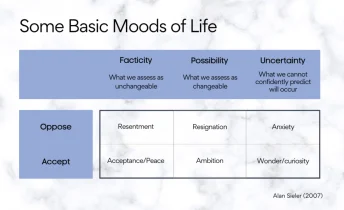
Sieler’s work suggests that moods and emotions aren’t simply fleeting states, they’re predispositions. They shape the actions we are likely to take, or avoid. And when a mood becomes persistent, it shapes our way of being.
He draws on Fernando Flores’ work to map three background assessments that influence our emotional orientation:
💡Facticity – What we assess as unchangeable
💡Possibility – What we assess as open to change
💡Uncertainty – What we assess as unpredictable
Let me show you:

Using the model:
😠 If we reject something unchangeable, we may feel resentment.
😕 If we deny all possibility, we fall into resignation.
😟 If we feel threatened by uncertainty, we act from a place of anxiety.
But if we accept what is, see what could be, and meet the unknown with curiosity — we open up space for wiser, more creative action.
Leadership Begins in the Self
This framework isn’t about denying emotion, or pretending to be serene at all times.
It’s about becoming more skilful at noticing where we are emotionally, asking where it’s coming from, and choosing how we want to respond.
It’s not always easy. But with coaching, self coaching and practise, we can expand our way of being and ability to take the actions we want to.
And it matters, because our moods shape our leadership. They affect how we interpret challenges, how we relate to others, what we see as possible.
In a time of rapid and unpredictable change, this kind of self-awareness and emotional literacy is foundational.
As Sieler puts it: “Our difficulty in coping may not mean there is anything wrong with us.” But we do need new ways to navigate.
And as Kegan writes, the key to adult development is not just solving problems, it’s developing the capacity to see in more complex ways.
Try This
Next time you find yourself emotionally hooked by a situation, ask:
- What am I assessing as unchangeable?
- What am I assessing as possible?
- What am I assessing as uncertain?
- And then ask yourself, is that assessment grounded? Is it helpful?
You might be surprised by what you learn.
If you’d like to explore how moods, language and embodied awareness can support your leadership, or the culture of your team, I offer coaching and team facilitation rooted in this approach.
📩 DM me or email me or book a chat on www.helenmgconsulting.com I’d love to chat!