
A Tale of Two Sculptures:
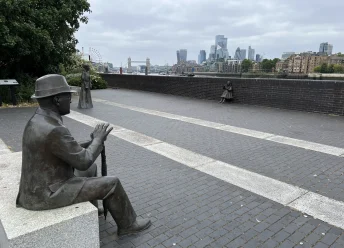
I have two favourite sculptures in London:
Dr Salter’s Day Dream on Bermondsey Wall East, and the recent Banksy sculpture at Wellington Place.
The juxtaposition of the two has stayed with me this weekend.

Dr Salter’s Day Dream depicts Dr Alfred Salter seated in stillness, gazing towards the figures of his wife Ada, their daughter Joyce, and their cat. The sculptures are set apart so that he appears to be summoning them through memory, perhaps in conversation with them in his mind.
I know of his work, but of course I do not know him.
Dr Salter qualified as a doctor in the late 1890s and moved to the then deeply deprived Bermondsey area with his wife Ada. Together they devoted themselves to public service and social reform. He offered medical care to those unable to pay, despite criticism from fellow doctors. Ada became the first female Labour mayor of a London borough. Both seemed driven by a profound commitment to human dignity and collective wellbeing.
Whenever I visit, I’m moved by the expression in Dr Salter’s eyes. There is something about the stillness of the sculpture that invites reflection rather than certainty.
And I find myself full of questions.
What sustained you?
Did hope outweigh despair, or did they live side by side?
What enabled you to keep on with your work after the death of your daughter?
Would you change anything if you had your time again?
What would you say to your younger self?
My ongoing commitment, practice and learning about coaching means I’m always interested in what questions are followed by a pause and deep thought. The sound of insight following a well placed question is silence.
And then there is the new Banksy.
I don’t see a single individual, more an amalgam of many. A figure carrying a flag high, head lifted, seemingly purposeful, yet unable to see clearly because the very thing he carries obscures his vision. He appears to be walking towards a void he cannot yet perceive.
I stood nearby listening to people discuss it. Some found it hopeful. Others found it alarming. Some simply appreciated art’s ability to disturb settled thinking.
Again, I found myself wondering about questions I’d like to ask the figure depicted if I had the opportunity. Not to corner or condemn, but questions that might create the conditions for reflection.
What do you see ahead of you?
Is anything obscuring your vision?
What concern are you wanting to take care of?
To what extent is your current course of action serving that concern?
How would you describe your mood?
What future do you hope for?
In coaching, I’m interested in how we create spaces where people can notice themselves noticing, where they can observe not only the world, but the lens through which they interpret it.
Robert Kegan writes in Immunity to Change about the movement towards a more self-transforming way of being: the capacity not simply to hold a perspective, but to reflect upon it, revise it, and consciously choose new action. That feels increasingly important.
We seem to be living through a time where difference quickly hardens into polarity; where challenge is often accompanied by aggression, certainty and personal criticism. In that environment, curiosity can feel fragile.
I keep returning to the possibility that thoughtful questions, deep listening, and genuine attempts to understand still matter.Not because questions alone change the world. There is, as ever, a mighty expanse between insight and action.
But change often begins with a pause.
A moment of noticing.
A slight unconcealing.
A chink of light through which another future becomes imaginable.
I don’t have any silver bullets.
But I remain committed to small acts of kindness where I can, and to asking questions that help both myself and others better understand what we are seeing and the meaning we are making of it.